
A/Prof Richard Fletcher Principal Investigator SMS4dads
When conducting a video reflective program with new fathers, visiting them with their baby every week and reviewing the brief video taken the week before, it was sometimes possible to see a dramatic shift in the father’s awareness. One father put it like this:
“anybody can change a nappy, anybody can pick him up if he is crying . . . but what I am looking for out of this is the interaction that you are missing . . . and that’s what I am picking up. Through the DVDs and the video I am picking up those little signals that William wants to interact…. started to see William as a real little person instead of a baby . . . we realised that even though he couldn’t do much that there was an individual in there trying to interact with us.”
It seemed clear from this work that when fathers were given the chance to move beyond simply managing their infant’s needs and really ‘seeing’ the baby in front of them, they could recognise “a real little person” trying to interact.

When we were preparing the first SMS4dads messages in 2014 we incorporated the voice of the baby into the antenatal as well as post birth messages up to one year. For example, before the birth this text is sent: 4dad: At 20 weeks my eyelids and eyebrows are forming and I can even blink! Not much to see yet but lots to look forward to dad. And at four weeks post-birth 4dad: Regularly singing or talking to me will help us connect to each other dad. I love the sound of your voice. Language development factsheet here [Web link].
One important strategy in the initiative is to articulate the perspective of the baby to fathers through our texts and resources. Another strand is to encourage clinicians to consider the perspective of the baby when supporting the family. In 2023 I met with three psychiatrists involved in family services to nut out why fathers were regularly not included. From these conversations we wrote a play to illustrate how competent therapists aiming to support the wellbeing of a presenting family might struggle to engage the father. A key moment in the dialogue made this point
“I think we should be asking ourselves: Where does this baby live? What is their context? Who does the baby trust, or need to trust? Where is the centre of their universe? For most babies, the centre of the universe is the house they live in and the people who live there, and fathers are usually a part of that, not always, but very often. Yet we operate as if that’s not true. Indeed, we operate as if the mental health service is the centre of the universe, and that our clinic rooms, our dyadic models, and our administrative processes are what should determine our approach to a family.”
We recognise that clinicians wish to engage fathers and seek to connect them to their infants. So when the concept of visuals linked to the texts was suggested by Dr Bronwyn Leigh we leapt at the chance to collaborate. The Speaking for the Baby visual resources provide a marvellous channel to support clinicians in their interactions with fathers. We are excited by the possibility of extending these resources to other important messages in partnership with The Centre for Perinatal Psychology.
The quotes above can be found in these research papers:
Fletcher, R. (2009). Promoting infant well‐being in the context of maternal depression by supporting the father. Infant Mental Health Journal, 30(1), 95-102. DOI: 10.1002/imhj.2020595 (open access)
Lim, I., McMillan, H., Robertson, P., & Fletcher, R. (2023). The missing father: why can’t infant mental health services keep dads in mind?. Australian and New Zealand Journal of Family Therapy, 44(4), 467-476. DOI: 10.1002/anzf.1560 (open access)
Dr Bronwyn Leigh
Founder and Director, Centre for Perinatal Psychology & Perinatal Training Centre
I was working as a perinatal and infant psychologist in a private practice setting and I’d been thinking for some time about, how to share information to parents in a digestible way about infant mental health ideas. I also wanted to provide resources for clinicians to use with parents to talk about infant mental health ideas in a palatable, digestible way.
I initially I just started doodling. I’m a visual person, and I learn visually. I wanted to get across the idea of the baby as the manual. Another very clear idea was when a baby turns away, because clinically, I had worked with so many mothers who were really distraught and distressed when their baby turned their face away making assumptions about the baby rejecting them.
I created all of the illustrations myself, because I had a vision in my mind of how I wanted them to look. And then came the idea of putting it in the language of the baby, the words of the baby. What would the baby be saying? What would we want the parent to be saying back or responding? So I sketched them all out, and then I did a Google search and found an illustrator (who it turned out lives close by)and we produced the first set of Speaking for the Baby handouts.
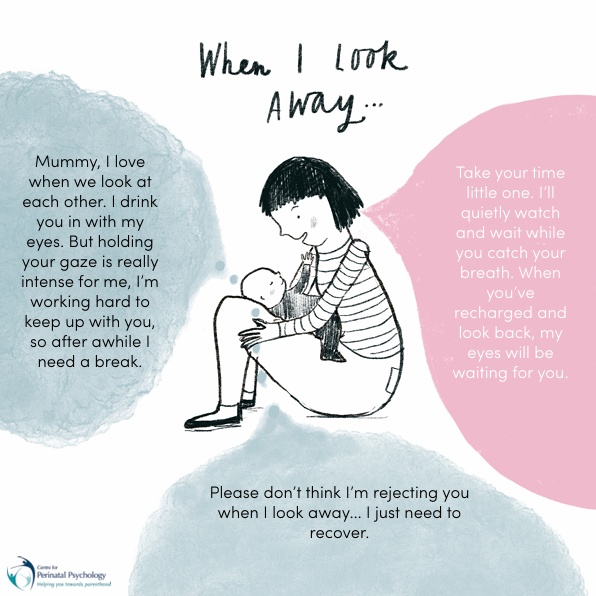
The first release was in 2018 with the hero image and four illustrations and matching handouts. In 2019 we worked on translating those illustrations into Dutch for an organisation in The Netherlands. In 2020, a further three illustrations were added and another four in 2025 just ahead of the SMS4dads collaboration. In the end there were 11 illustrations with three specifically for dads.
I had been aligned with SMS4Dads for some time and had been involved in providing feedback on some of the messages. We were sent draft messages and asked to say whether or not they made sense, were they intuitive, did we think the message was evidence-based? And if so, what was the relevant evidence?
In 2025 I attended the Fatherhood Research Symposium in Melbourne and afterwards thought that more dad-specific resources were needed. Trying to decide what the key messages for dads would be I retrieved the file of text messages from SMS4dads from my involvement in 2016! When I found the message that was to be sent 12 weeks after the birth “4dad: When you hide your eyes while playing peek-a-boo I think you have disappeared. When you take your hands away… its magic! Gets me every time dad” I thought that this message just lends itself so beautifully to an illustration for speaking for the baby, I could just see it in my mind. That’s when I emailed Richard and we went from there.
Richard’s research revealed possible long-term negative impacts on the children of dads with mental health issues. Fathers’ depressive symptoms in the first year after the birth predicted behaviour problems in their children years later.
“If dads’ mental health has such a dramatic impact then we need to be screening dads for depression, not just mums,” Richard explains.
In response to these limitations, Richard and his team have designed a smart-phone based program that allows mobile connection for new and expectant dads.
Participants receive texts containing information and links, and self-report their mood. If the mood tracker identifies dads as needing extra support, they will be offered a phone call from a counsellor trained in this area.
Following the success of the pilot of the SMS4dads program, Funding was received to enable a National roll-out.
“When dad’s miss antenatal classes or activities, they also miss out on contact and links to other people. They may never get the chance to say to anyone, look I’m really stressed,” he points out.
“SMS4dads is a way of bringing dads into the health system and keeping them linked in with services and support,” explains Richard.
Richard credits a varied career, a talented and innovative team, and much life experience for affording him the insight needed to address the challenges related to actively engaging dads.
After completing his masters in Medical Science, studying epidemiology, Richard earned his PhD focusing on fathers and attachment.
“Fathers are invisible in many places, and that is endemic. Not because people dislike fathers, but because the system is set up to be focused on mothers.”
Some services and organisations are aware of the need to engage dads, but have been unsuccessful in their attempts.
“When people are challenged about this, they generally want dads involved,” Richard affirms.
“Often, however, they just don’t know how to do it.”
Richard works with health professionals on issues related to fathers, and has delivered many antenatal programs for expectant dads.
He credits his own family with giving him an understanding of the role of fathers needed to make his work relevant.
“I have three daughters and two stepdaughters,”
“My kids would say they taught me just about everything I know and they’d be right. They’ve taught me a lot, and still do.”
Richard’s research revealed possible long-term negative impacts on the children of dads with mental health issues. Fathers’ depressive symptoms in the first year after the birth predicted behaviour problems in their children years later.
“If dads’ mental health has such a dramatic impact then we need to be screening dads for depression, not just mums,” Richard explains.
In response to these limitations, Richard and his team have designed a smart-phone based program that allows mobile connection for new and expectant dads.
Participants receive texts containing information and links, and self-report their mood. If the mood tracker identifies dads as needing extra support, they will be offered a phone call from a counsellor trained in this area.
Following the success of the pilot of the SMS4dads program, Funding was received to enable a National roll-out.
“When dad’s miss antenatal classes or activities, they also miss out on contact and links to other people. They may never get the chance to say to anyone, look I’m really stressed,” he points out.
“SMS4dads is a way of bringing dads into the health system and keeping them linked in with services and support,” explains Richard.